The Principles of Continuous Action

In this post I turn to the issue of what constitutes continuous action. Consider the recurrent scene in which the protagonist and the antagonist of a film are locked in some type of combat and pause to banter, and after exchanging insults, resume their fight. Do we treat the scene as a whole as continuous action and the pause in action a mere blip? Or should we consider the banter as a more significant interruption that separates the action into two separate moments? The question poses the problem of interruptions in action. Since interruptions can assume many forms, this post will consider the cases in which interruptions do not entail discontinuous action and the cases in which they separate action into distinct moments.

Attack (1956)

Combat films are usually noted for the showcasing of battle sequences, normally situated in outdoor settings. However, Attack (1956) was based on Norman Brooks 1954 play Fragile Fox. Robert Aldrich decided to retain the theatrical dimension of the story by having the narrative focus of the German Advance sequence on the drama taking place inside the command post while the action scenarios instead primarily serve as exterior background context.

Back to Bataan (1945)

Like other combat films of the period, Back to Bataan (1945) relies heavy on sound design to help shape the auditory and visual space of the battle field. In addition, depictions of violence in combat films also were constrained by the strictures of the Production Code. As a result, certain scenes of potential graphic violence in the film are rendered off screen, in shadow, or only the aftermath is presented.

Bad Boys II (2003)

The Haitian heist sequence is among the longest action sequences appearing in the first act of a film. At close to a 15-minute running time, the sequence takes up more than 37% of the first act, creating an unusual 2-3-4-1 action structure in which over 61% of the total action in the film is placed within its first 40 minutes. In terms of action scenarios, the sequence primarily consists of an attempted heist that segues into an extended and highly destructive pursuit.

Batman (1989)

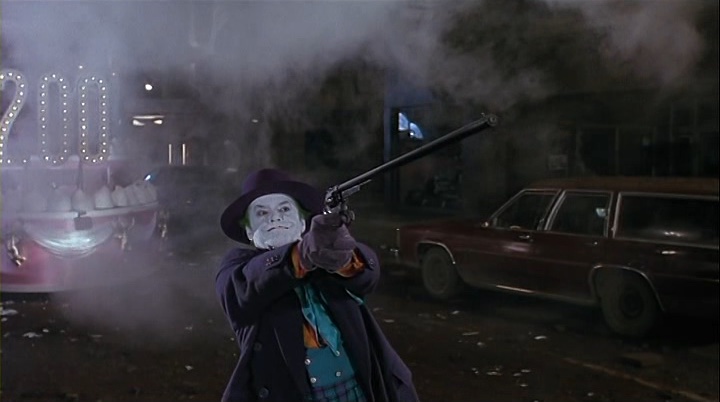
The sequence has distinct plotlines that primarly follow the story paths of Batman, the Joker and Vicki Vale. What is noteworthy is that not only do these plotlines converge as a means to signal to the viewer that the sequence is coming to its climax but also the converge is executed on the planes of action.